Flocks & houses
Flock setup, house assignments, transfers, splits, lifecycle history and farm-specific configuration.
FERMA_SUITE is a multi-farm poultry management platform for breeder and rearing operations. Each farm can keep working locally without a permanent Internet connection, while headquarters receives consolidated production, flock, workforce and KPI data through controlled synchronization.
Each farm uses its own local database for normal work. When data needs to move, the system exchanges structured packages and confirms processing. The central environment consolidates history for management applications without becoming a single point of failure for daily farm entry.
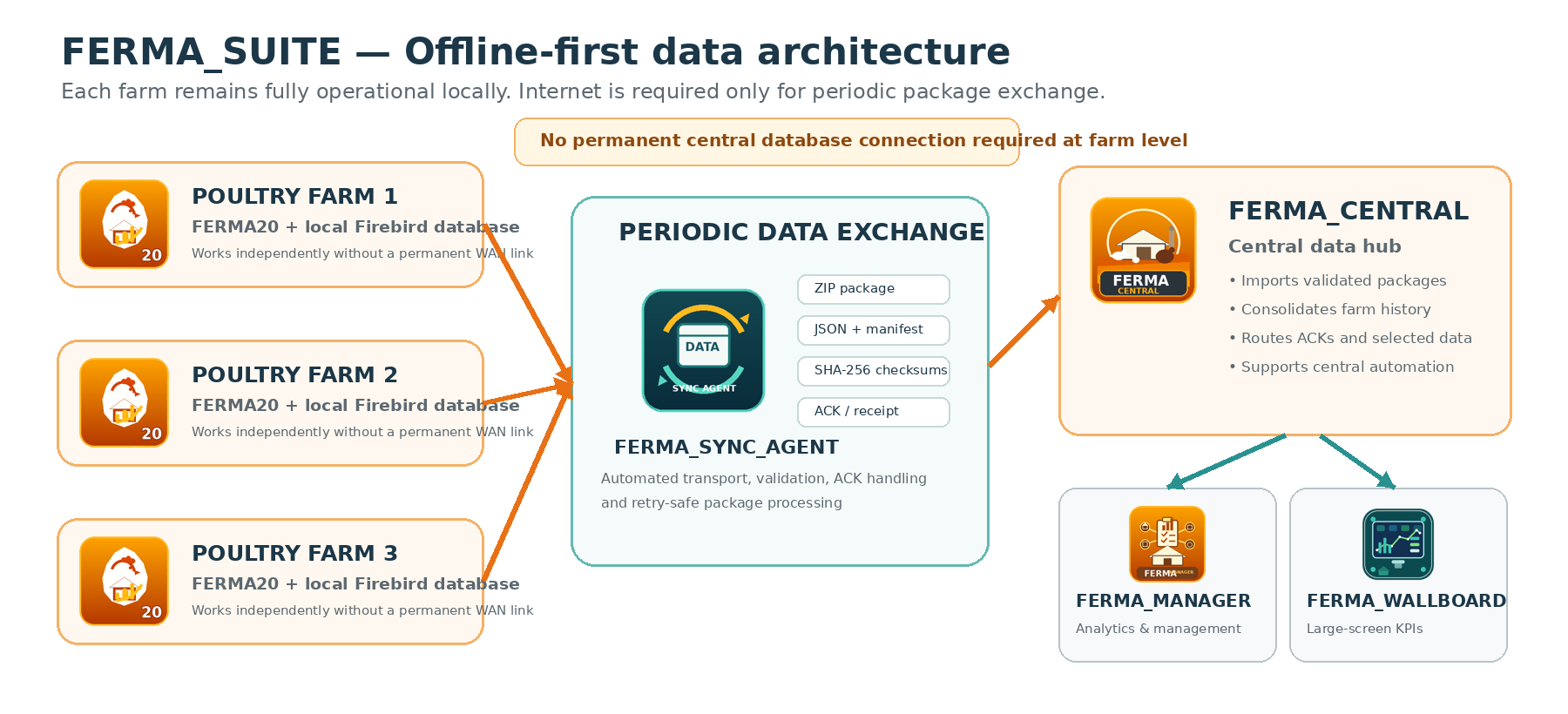
The platform separates farm-side operational work, multi-farm consolidation, automation, management analysis and large-screen KPI visibility.
The local operating system for daily poultry-farm work: flock and house lifecycle, production records, egg warehouse and dispatch, rearing, breeder operations, workforce, veterinary and laboratory workflows, imports and local reporting.
Receives validated farm packages, consolidates cross-farm history, maintains organizational mappings and provides the trusted data layer used by central reporting, management applications and selected routing.
Automates transport, package processing, acknowledgements, retry handling, scheduled jobs and selected downstream routing without requiring a user to keep an application screen open.
Turns consolidated data into cross-farm dashboards, flock analysis, rearing and breeder comparisons, workforce views, KPI logic, veterinary visibility, planning and data-quality control.
Provides a read-only, large-screen view of selected production and workforce indicators so management can notice missing data, below-target performance or operational deviations quickly.
Flock setup, house assignments, transfers, splits, lifecycle history and farm-specific configuration.
Egg collection, egg quality, mortality, culling, bird stock, comments and completeness checks.
Farm-side egg stock, receipts from production, reconciliation, dispatch documents, waste and movement history.
Body weight, mortality, feed and supporting records with analysis and continuity into breeder/laying performance.
Laying performance, norms, insemination-related workflows, fertility feedback and flock analytics.
Employees, schedules, attendance, actual hours, deviations and central management views.
Veterinary events, programs, laboratory orders, result processing and links between findings and farm events.
Preview, validation, conflict detection, overwrite/skip decisions and import history for legacy or parallel data.
Cross-farm comparisons, trends, norms, KPIs, central calendars and drill-down to farm and flock detail.
Individual farms need practical tools for daily records; managers need comparable information across farms. FERMA_SUITE is designed for both responsibilities.
Yes. Farm-side FERMA20 uses a local database, so core production records, flock information and local reporting are not dependent on continuous connectivity with headquarters.
FERMA_CENTRAL consolidates validated farm packages. FERMA_MANAGER provides a cross-farm view of flock history, laying and rearing performance, norms, workforce and selected veterinary information.
Yes. Farm configuration determines the production domain, with workflows for rearing data such as weekly weights and mortality and for breeder operations such as hatching eggs, laying performance and fertility-related feedback.
Where deployed, the integration connects relevant farm dispatch data and hatchery-side receiving or biological feedback through controlled data exchange rather than relying on repeated manual entry.
For the hatchery-side process, see HATCHERY management software and its hatching egg traceability workflow.
FERMA_SUITE separates local operational continuity from central visibility. That makes it particularly useful in distributed agricultural environments where connectivity can be intermittent, while management still needs consistent consolidated data.
We can discuss the current farm processes, data sources, connectivity constraints and the management information you want to build on top of them.